

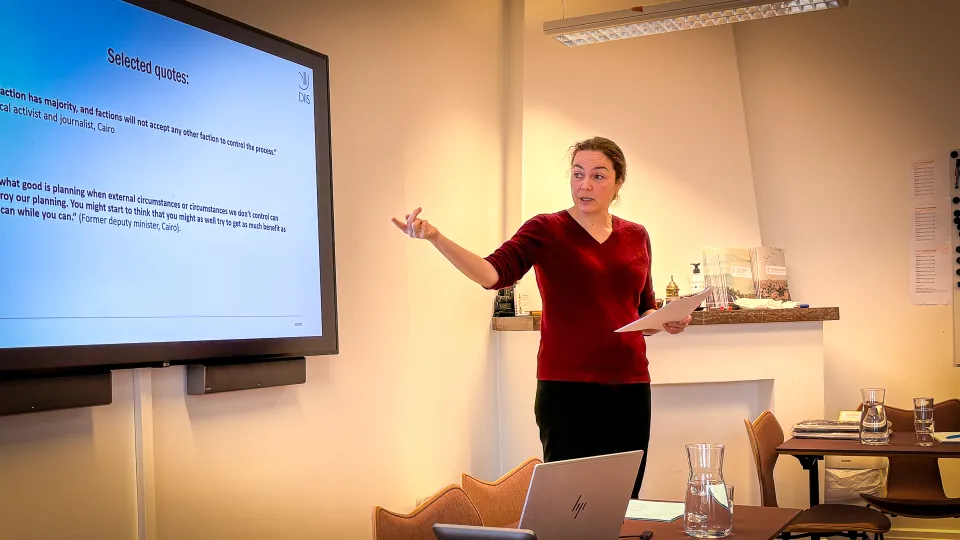
The seminar featured Maria Louise Clausen from the Danish Institute for International Studies. Her talk examined how governance structures formed during ongoing conflict shape the prospects for peace in Yemen.
Clausen focused particularly on the role of interim or transitional governing arrangements linked to Yemen’s internationally recognised government. Such institutions are often designed to guide countries from conflict towards elections and political stability. In Yemen, however, these arrangements have lasted for more than a decade and continue to influence the country’s political system.
She also highlighted how the conflict in Yemen is often interpreted through simplified external narratives, such as regional proxy rivalry or sectarian divisions. While these perspectives capture some elements, they risk overlooking the complex internal political dynamics and struggles over authority and representation among Yemeni actors.
Clausen emphasised that transitional governing structures are not only temporary arrangements. Decisions taken during these periods can have long-term effects on political institutions and influence which actors gain power in a future settlement.
Key points from the seminar
- Transitional governance can shape long-term political structures.
- Yemen’s conflict cannot be understood only through external narratives.
- Struggles over authority and representation remain central to the conflict.
- Yemen continues to exist in a prolonged phase between war and peace.
Next CMES Seminar: 12 March 2026 13:15 at CMES, Finngatan 16, Lund
Qur’anic Gardens and Muslim Environmentalism: Religious Environmental Ethics in Practice
Welcome!