Interconnected crises: Conflict, climate, and the struggle for peace
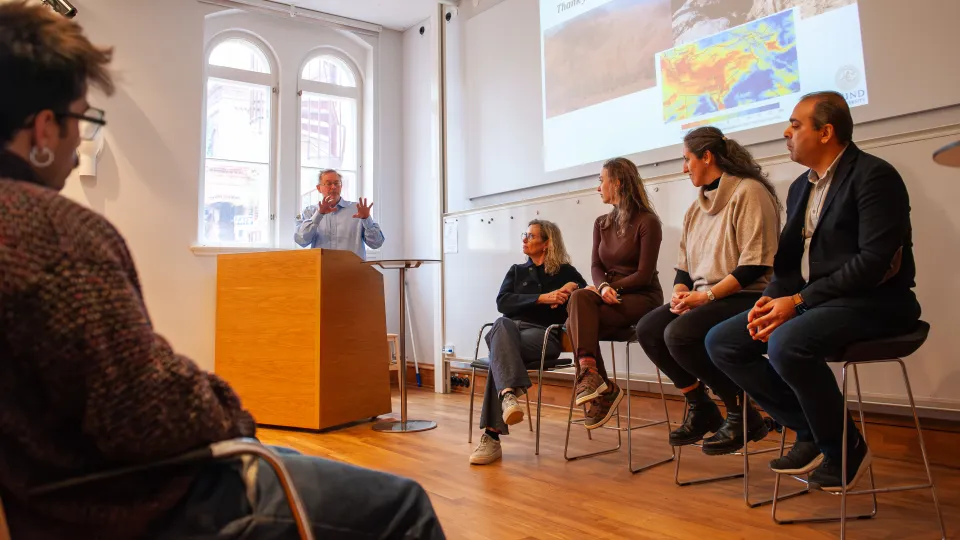
The panel opened with a reflection on the Middle East as a region marked by both protracted conflict and acute environmental challenges. Ronny Berndtsson (CMES Director) highlighted how issues such as water scarcity, climate change, and political instability are deeply intertwined, creating what he described as a “poly-crisis” where multiple crises reinforce each other.
The prospect of sustainable peace diplomacy
Professor Karin Aggestam (CMES, Political Science) emphasised the need to “re-imagine diplomacy” in the region. She argued that sustainable peace diplomacy must go beyond ceasefires and address the underlying causes of conflict.
“To talk about sustainable peace diplomacy is not just the absence of war, but actually focusing on long-term engagement, commitments in diplomacy, very much focused on a process-oriented diplomacy,” Aggestam explained.
She stressed the importance of inclusivity, local anchoring, and justice in peace processes, warning that approaches based on “peace through strength” and exclusion risk perpetuating cycles of violence.
No sustainability without peace: The Kurdish question
Dr Pinar Dinc (CMES, Political Science) explored the relationship between conflict and environmental destruction, focusing on the Kurdish regions spanning Turkey, Syria, Iraq, and Iran.
She highlighted how environmental damage, such as burned forests, polluted water, and confiscated farmland, is often dismissed as a side effect of conflict, but in reality is deeply political and structural.
Dinc talked about the concepts of “peace ecology” and “green transitional justice,” frameworks that call for post-conflict recovery to include ecological restoration, local participation, and justice for both human and non-human victims.
“Sustainability, in its deeper sense, is about what kind of future becomes possible. Who benefits from the reconstruction of Syria or Gaza? Who gets to decide what sacrifices are made in the name of development and growth” she asked.
Everyday peacebuilding with nature in North and East Syria
Dr Maria Andrea Nardi (CMES, Human Geography) shifted the focus to grassroots initiatives in northern Syria, where communities are attempting to restore ecosystems and build peace in the aftermath of conflict.
She described how local projects, such as tree planting, agroecology, and water management, are not only about environmental recovery but also about social cohesion and challenging extractive, top-down models of development.
Nardi emphasised the importance of “making peace with nature” and highlighted the Kurdish approach of integrating ecology, grassroots democracy, and women’s empowerment into everyday life.
The Middle East under pressure: Water, drought, and dust storms
Dr Hossein Hashemi (CMES, Water Resources Engineering) provided a stark overview of the region’s water crisis.
He explained that the Middle East receives far less precipitation than Europe, and much of its water is lost to evaporation.
“The area is already exhausting water resources… and most models project that the region will get warmer, with less rainfall and more evaporation,” Hashemi noted.
He described how inefficient agricultural practices and over-extraction of groundwater are leading to land subsidence, shrinking lakes, and an increase in dust storms. Phenomena with severe consequences for both ecosystems and human health.
Local action and regional challenges
The panel concluded with a discussion on the need to connect local peacebuilding and environmental initiatives with broader diplomatic and political processes.
Speakers agreed that durable peace and sustainability in the Middle East require both grassroots engagement and political will at the highest levels.
As Professor Aggestam summarised, “If you want to secure a durable peace, the peace needs to be locally anchored… but you also need the economic and political incentives to sustain what is being built locally.”
About Sustainability Week
Sustainability Week is an annual event in Lund, organised jointly by Lund University and Lund municipality. The week serves as a platform for bringing together ideas, raising public awareness, and inspiring sustainable change. In 2026, Sustainability Week runs from 13–18 April and features a wide range of lectures, workshops, and discussions on pressing sustainability challenges.
For more information about upcoming CMES events, visit www.cmes.lu.se/calendar/.